Can AI do a construction takeoff? What general models miss on drawing sets

Ask ChatGPT or Claude to count the same plan set ten times and you can get ten different answers, each delivered confidently. So can AI tools really do a construction takeoff? LLMs fake their way through it, but to send an accurate, winning bid, you need AI that can truly read the drawings, which is only possible with computer vision.
Here, we'll cover what general models miss on a drawing set, why a better prompt can't close the gap, and what computer vision is and why it's crucial for an AI takeoff.
Table of contents
- Why can't LLMs and AI tools like ChatGPT, Claude, or Gemini do a construction takeoff?
- What is computer vision and why does it matter for takeoffs?
- Where general AI tools can help estimators
- The bottom line
- Frequently asked questions
Why can't LLMs and AI tools like ChatGPT, Claude, or Gemini do a construction takeoff?
1. General models aren't trained on construction drawings
General models learn from broad collections training data that are not focused on construction plans. A receptacle symbol, a plumbing legend, or a panel schedule looks different from one trade, architect, and country to the next, so a model that wasn't built around those conventions and nuances ends up guessing at what a symbol means. A model trained on a trade's own drawings starts out knowing what to look for, and improves the more drawings it sees.
2. LLMs can't read construction drawings properly (or economically)
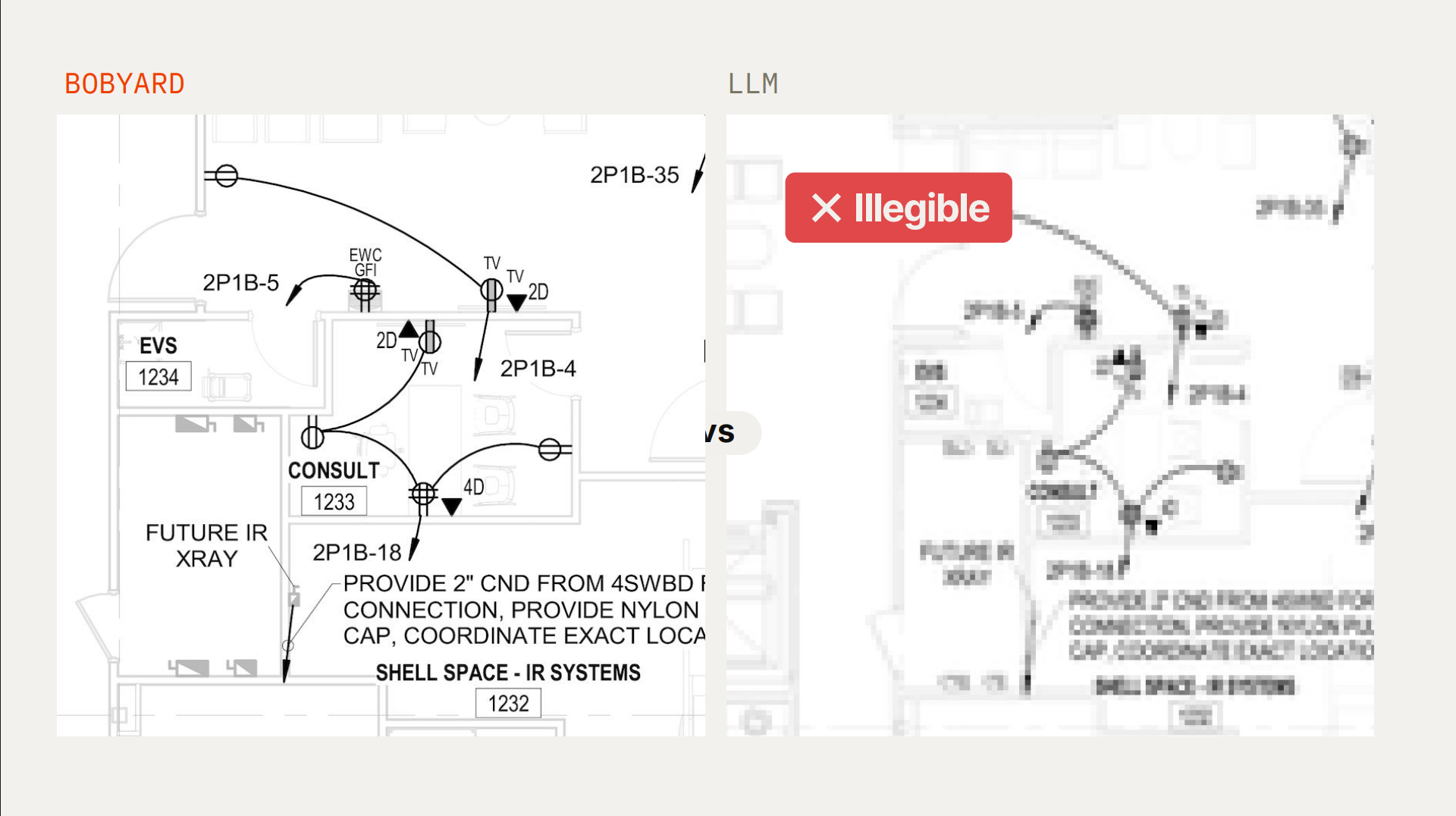
General models are built to read and write text. They don't have computer vision capabilities, so they struggle with the size and detail of construction drawings. Plans can sit around 15,000 x 10,000 pixels or more, but LLMs resize them to 1/10 or less of that size, making them illegible.
You could force it to process the full-size sheet, but the processing time and cost will rise substantially. You might eat up a month of tokens before you finish the bid.
3. Important takeoff and estimate data get disconnected
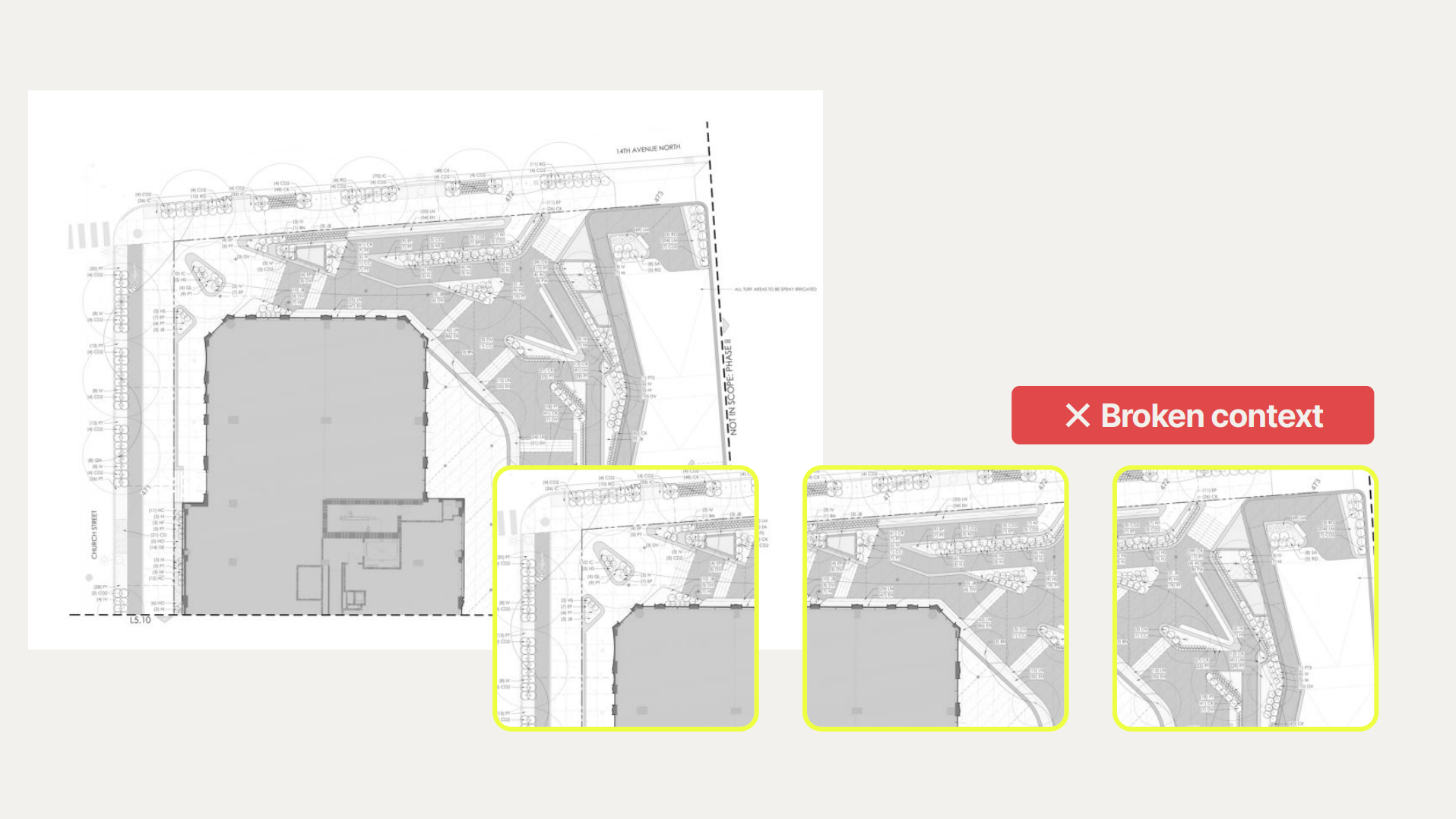
Even if the drawing stays legible, general AI models read an image by cropping it into tiles to make it more manageable, but this breaks relationships across the tiles.
A model working one tile at a time can't answer a question like "how much will the interior finish of this building cost?" Or maybe you get a count of shrubs but the plant schedule is on a different tile so it doesn't give you the species or sizes to price them correctly. Estimators have to connect the dots manually, which defeats the purpose.
4. LLMs can be inconsistent and inaccurate with total confidence (aka "hallucinations")
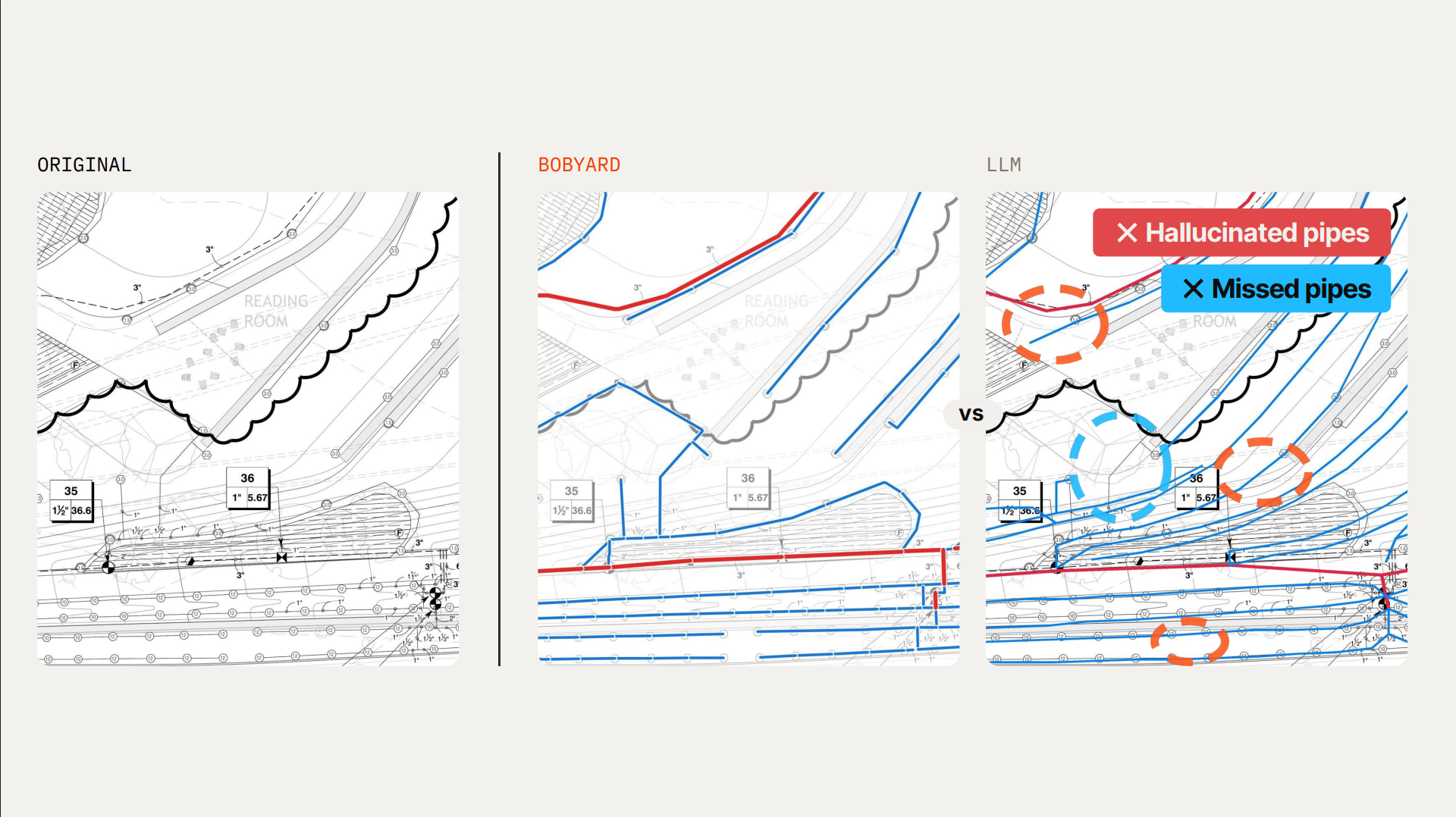
Run the same plan set through an LLM multiple times, and you can confidently get a different answer for each run. That's because general LLM models are probabilistic. Even with text based inputs, you're likely to get different results. When it hits a symbol it can't read, it fills the gap with a plausible guess and moves on, and that's by design. It can't tell you where it might be wrong.
For an estimator, that means no signal about which counts to check, so everything has to be rechecked.
Can you close the gap with better prompts?
The limit is around how general models intake images and write answers, so no matter how good your prompt is, it can't change the engine powering the answer.
Exact counts, shapes, and links across pages need specific models built to produce them and computer vision to see them, which is why Bobyard's AI is different.
What is computer vision and why does it matter for takeoffs?
Computer vision is the branch of AI that teaches software to "see" and understand images so it can read construction drawings like an estimator.
A computer vision model finds each object on a sheet and marks exactly where it is by outlining an area, tracing a line, or tagging a point. It's the critical piece of AI that matters for takeoffs and estimates, and why tools like ChatGPT, Claude, or basic AI features in other construction software aren't enough, because they can't do this.
You need to see results on the plan, not as text
Counts, areas, lines, and associations that come back as shapes on your plan, and highlight when you click them mean you can verify and comprehend them in seconds. This is a huge factor as to why Bobyard customers can run takeoffs 50-90% faster and unlock estimator productivity in a way that implementing general AI won't.
An LLM might spit out a list of numbers, which still means paging through sheets to find where each one came from and check it. Or it might give you results that seem correct but you have no way of knowing. Both defeat the purpose of trying to use AI to save time, improve accuracy, or win more bids.
Where general AI tools can help estimators
However, this doesn't mean general AI tools have no place on the bid desk. General AI tools can help most with text-based work, like:
- Summarizing specs and RFPs
- Drafting subcontractor requests and RFIs
- Comparing subcontractor bids
- Writing scope language
- Drafting proposals
Bobyard also puts this kind of AI to work too in our product, just not to read drawings. Once the takeoff is done, it helps with additional steps towards the bid.
- Ask Bob AI assistant — You can Ask Bob anything about your specs, drawings, or RFI log. He's read the whole project and can give quick answers.
- Estimates and proposals — Takeoff quantities flow into your cost database and estimate table, then into a branded, client-ready proposal you can export without leaving Bobyard.
- Submittals — Bobyard hunts spec sheets for you by searching your product library and the web for each item, then formats it into a GC-ready PDF for you.
In each case, the AI does the searching, reading, and drafting for you, leaving the estimator and their expertise to make the final call.
The bottom line
General AI models are incredible at reading and reasoning with text, but that's why they fall short for takeoff work—which needs exact counts, measured shapes, and clear connections across sheets that are verifiable. The only way you get that is with computer vision models trained on trade drawings.
Want to see the difference on your own plans? Book a demo and send us a set from a past bid so you can see the difference Bobyard makes and check our work.
Frequently asked questions
Can ChatGPT, Claude, or Gemini do a construction takeoff?
No. ChatGPT, Claude, and Gemini can't reliably do a construction takeoff. They're strong at text, so they can summarize specs or pull line items from a bid form. A takeoff is different work. They have to shrink or tile large sheets and answer in typed text, so they can't give exact counts or link details across sheets. They're also probabilistic, so the same plan set can return a different answer every run, and the model will make its best guess when it hits something it can't read.
Does a specific prompt or more advanced AI model help you run a better takeoff?
The limit comes from how general models take in images and write answers, and how the model is trained. A better prompt doesn't change the engine underneath it.
Why does computer vision matter for a construction takeoff?
A takeoff needs exact points, lines, and areas marked in the right place, and computer vision is the AI built to read images and return that geometry, so every count can be checked on your plan. That's why Bobyard customers can run takeoffs 50–90% faster and even see higher win rates.
Does Bobyard use ChatGPT or another general model?
Bobyard uses a language model only where text matters, such as reading a request or a legend. Our own computer vision models read the drawing itself, outlining areas, tracing lines, and labeling items right on your plan. These are proprietary and unique to Bobyard.