Estimates were created to answer, “what will this cost?” That's still true. But at BuiltWorlds' GC Conference this year, the conversation pointed to estimating as something much bigger: predictive planning.
Estimating is becoming the layer where everything upstream across design constraints, procurement realities, scheduling, sequencing, risk all come together to shape a smarter, more predictive number. Instead of reacting to problems once they surface in the field, contractors are starting to use data and AI to catch them before ground is ever broken.
Naturally, it’s a direction we’re excited to see the industry lean into, but there’s still a gap before it can get there that BuiltWorlds’ speakers highlighted. Below, we go into what that gap is, and what closing it means.
Key takeaways from BuildWorlds' GC Conference
- Disconnected systems are converging. Design, estimating, procurement, scheduling, and logistics are no longer operating in isolation.
- AI doesn’t replace people, it makes them more strategic. The most useful applications process complexity so experienced estimators can focus on more strategic work.
- Estimates are the foundation for predictive preconstruction Estimating now factors in design, procurement, scheduling, and risk, not just cost.
- Prediction is replacing reaction. The competitive edge is shifting toward catching problems before construction starts.
- Real AI-native ability to read blueprints is the foundation that unlocks the rest. Reading blueprints trade by trade, has to come before any of the more exciting predictive capabilities can be trusted.
Construction is still early in its digital transformation
There was a clear thread across each discussion: construction is still early in its digital transformation. That leaves lots of room for software and AI to come into play, but that can’t happen without coordinated efforts and buy-in across operations, estimating, project management, and field teams. This is also why tools that tend to break through are the ones that already fit into how construction businesses already work, rather than rebuilding around new tools and technology, which can be disruptive—even when that disruption might be precisely the thing that’s needed.
Why contractors have been (rightfully) skeptical of big technological promises
Tons of contractors want access to cutting-edge technology, but they’re disillusioned by what they’ve seen so far. They’re often promised something big, and instead get an incremental improvement. Marginal improvements aren’t going to move the needle, whereas tools that can double or triple results will. BuiltWorlds’ talks emphasized that preconstruction and estimating are areas where this transformation is ripe.
With AI fears and hype muddying the water for many, BuiltWorlds’ panelists assured that AI’s role isn’t to replace skilled workers, but enhance their strategic output. AI can process a volume of project data that no person could get through manually, then surface what actually matters inside of it. Estimators, project managers, and superintendents who understand a job site don’t get displaced by AI, they become leaders who decide what to do with its outputs.
The estimate is becoming construction's intelligence and decision layer
Estimating is no longer just a one-time deliverable. Instead, it’s becoming a strategic foundation that downstream decisions get built on. More than just assessing cost, estimates are starting to draw on:
- Design constraints
- Procurement and material availability
- Scheduling realities
- Resource allocation
- Sequencing dependencies
- Risk data
to produce a number that reflects what's actually buildable, not just what's on the plans.
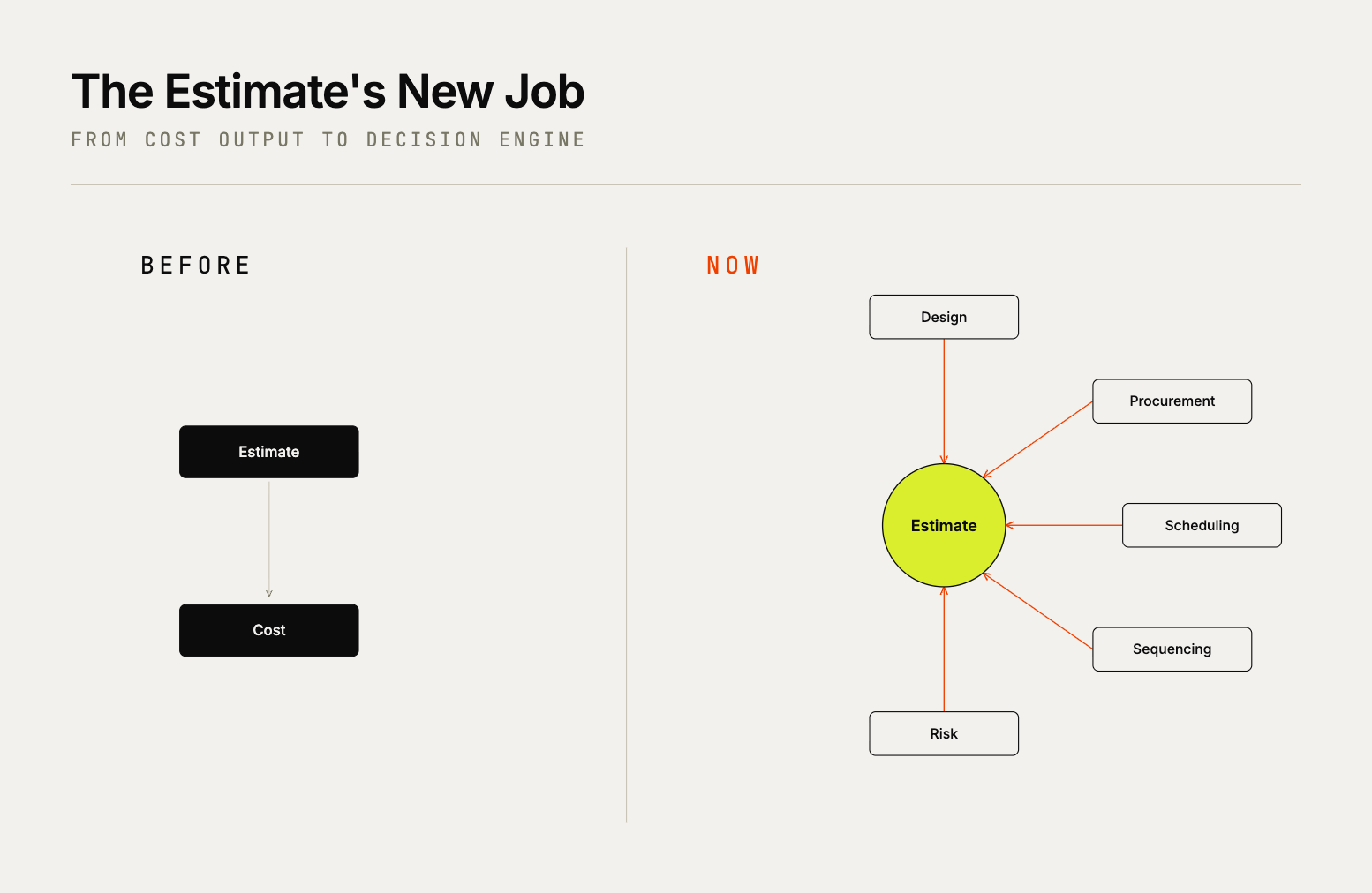 Estimates are chock full of key line items that encode assumptions about materials, labor, sequencing, and risk that rarely make it past the bid stage. If the estimate can shift to become a living decision engine (rather than a static document that gets filed away once a job is won) that shifts what’s possible in preconstruction, and the overall construction business strategy. Tools that are able to improve this meaningfully can move the needle for contractors and the industry at large.
Predictive planning is replacing reactive planning
What is predictive planning in construction?
Predictive planning means using data and AI to surface risks like coordination conflicts, schedule bottlenecks, and resourcing gaps before construction starts, rather than discovering them in the field and reacting after the fact.
 The panelists at BuiltWorlds pointed to benefits like:
- Earlier identification of coordination risk
- Dynamic schedule optimization
- Better labor allocation
- Fewer downstream delays
- More predictable project outcomes
Panelists emphasized again and again that by shifting more and more decisions upstream to preconstruction, they’re not only easier to get right, but also “cheaper” to get wrong (compared to when you’re mid-construction.)
AI needs to understand construction drawings before predictive preconstruction works
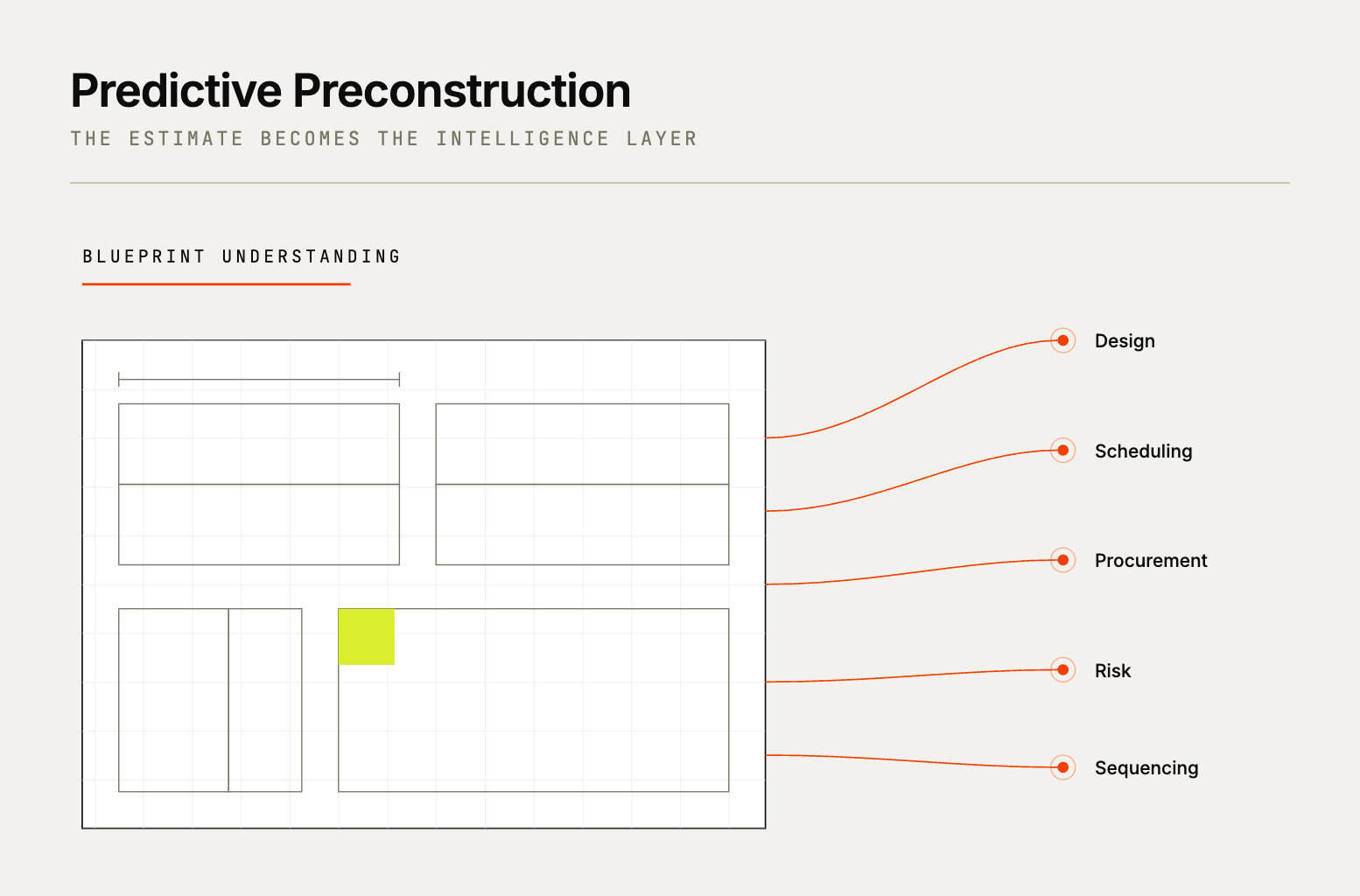
Plenty of GC innovation leaders spoke confidently about 3D modeling, digital twins, predictive estimating, AI-driven scheduling, even autonomous preconstruction. They represent a major direction the industry is headed in. But every one of these capabilities depends on a prerequisite that didn’t get tons of airtime: AI needs to read construction drawings at an expert level, for each trade.
Before software can reason about scheduling, procurement, sequencing, or risk, it first has to have the intelligence and ability to truly read the plans those decisions are based on, otherwise it will make mistakes.
This is the part of the stack that's least visible but most foundational, and where Bobyard is placing our bet. We’re developing real computer vision that can read blueprints like a skilled estimator, and training our models trade by trade. Most other solutions offer general purpose AI models wrapped around construction terminology and blueprints it can’t really distinguish or understand, to end up offering a marginal improvement, not an exponential one.
Where this leaves predictive preconstruction
The future of estimating isn’t just about getting a number out faster, but becoming a full-fledged intelligent decision-making system that helps estimators and contractors make better decisions across the entire preconstruction phase. That foundation starts with solutions that can genuinely understand construction drawings, trade by trade. Everything else gets built on top of it.