
The first part of this whitepaper series examined the lack of venture funding in the landscaping industry, comparing and contrasting landscaping to other similar fields that have received healthy VC funding. VCs have shied away from landscaping because they don’t see processes that lend themselves to standardization and automation.
Despite the operational complexity of landscaping (especially relative to other trades, despite their similarities) a crucial landscaping workflow that capital may be overlooking is estimating. In landscaping, estimating is sometimes seen (especially by outsiders) as merely an administrative task to submit a proposal.
Instead, estimating should be thought of as the landscaping operational model. It is the upstream driver of revenue generation, labor allocation, procurement, scheduling, and margin growth. Part 2 of this series examines the estimating process, and how and why it might be the ideal operational for major investments.
Table of Contents
- Part 1: Not just administrative, estimating is the first operating model for the job
- Part 2: Workflows remains manual because they comprise the hardest-to-standardize knowledge
- Part 3: Estimating is the operational layer that should attract capital and technological advancement
Part 1: Not just administrative, estimating feeds business margins
In the construction sector, companies with robust, repeatable preconstruction processes enjoy higher client satisfaction and profitability relative to peers without strong frameworks. Higher performers report having a formal, agreed-upon preconstruction process that occurs early in the project and whose directives are consistently followed.
In the landscaping industry, takeoffs and estimates are the preconstruction routine, but it hasn’t achieved the repeatable, formalized approaches that the larger sector has achieved. This is partly due to the fact that landscaping jobs are less uniform—both in the nature of the materials, how they’re tracked as symbols on a blueprint, and what kind of work they may entail (see more on this in the next section). The lack of a standardized preconstruction process and blueprints is why landscaping companies may execute well in the field and still lose money on a project.
Before a landscaping company begins an estimate, it must first decide if the bid is worth pursuing. The bid/no-bid decision is one of the earliest and most consequential moments in the operating pipeline, and can be one of the most time-consuming to prepare. Responding to an RFP requires time from estimators, project managers, broader operations teams and, occasionally, company leadership. Poorly aligned bids waste scarce capacity, and moving too slowly means missing out on jobs that could be a good fit.
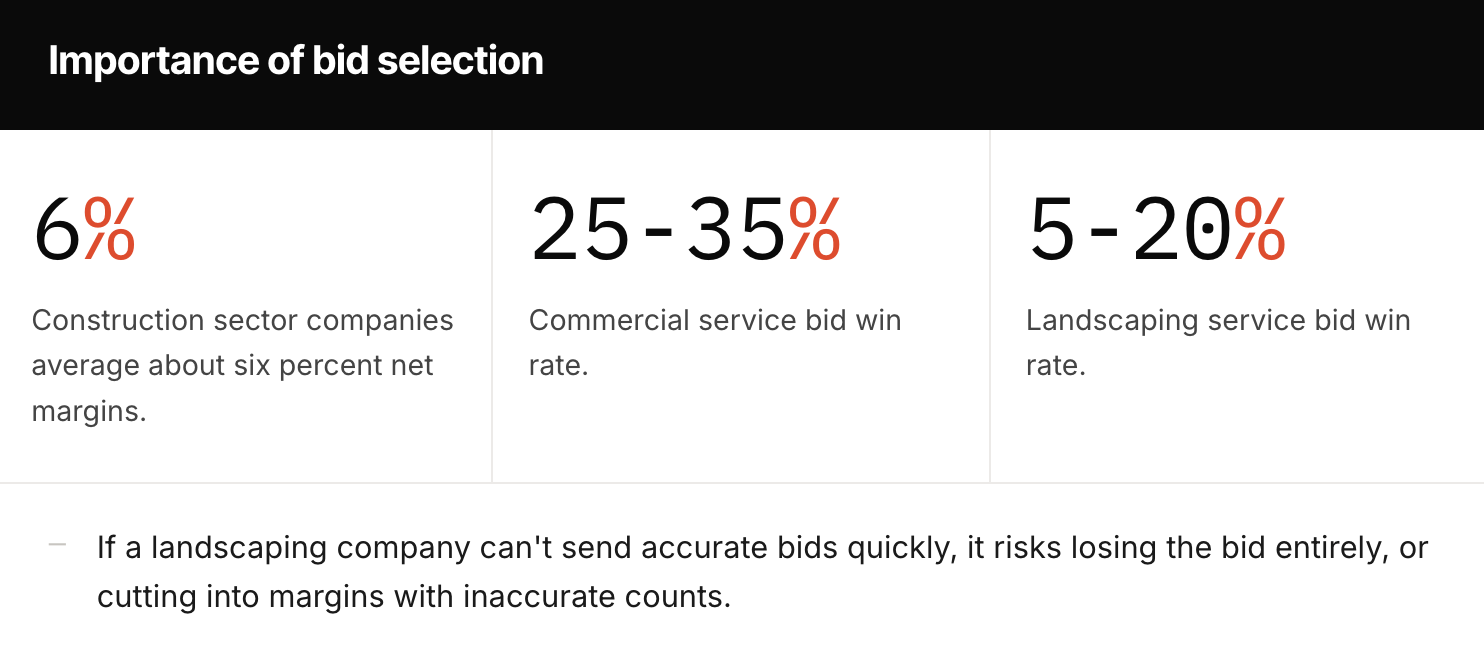 Importance of bid selection table sources:
If the company decides to pursue a bid, it then performs a takeoff and estimate. During takeoffs, landscaping companies measure and quantify items directly from clients’ plans and blueprints. Measurements include square footage, linear feet, counts of fixtures and plant elements and volumes of soil or other materials, among others. The goal of a takeoff is to turn measurements into an accurate scope required to complete the project.
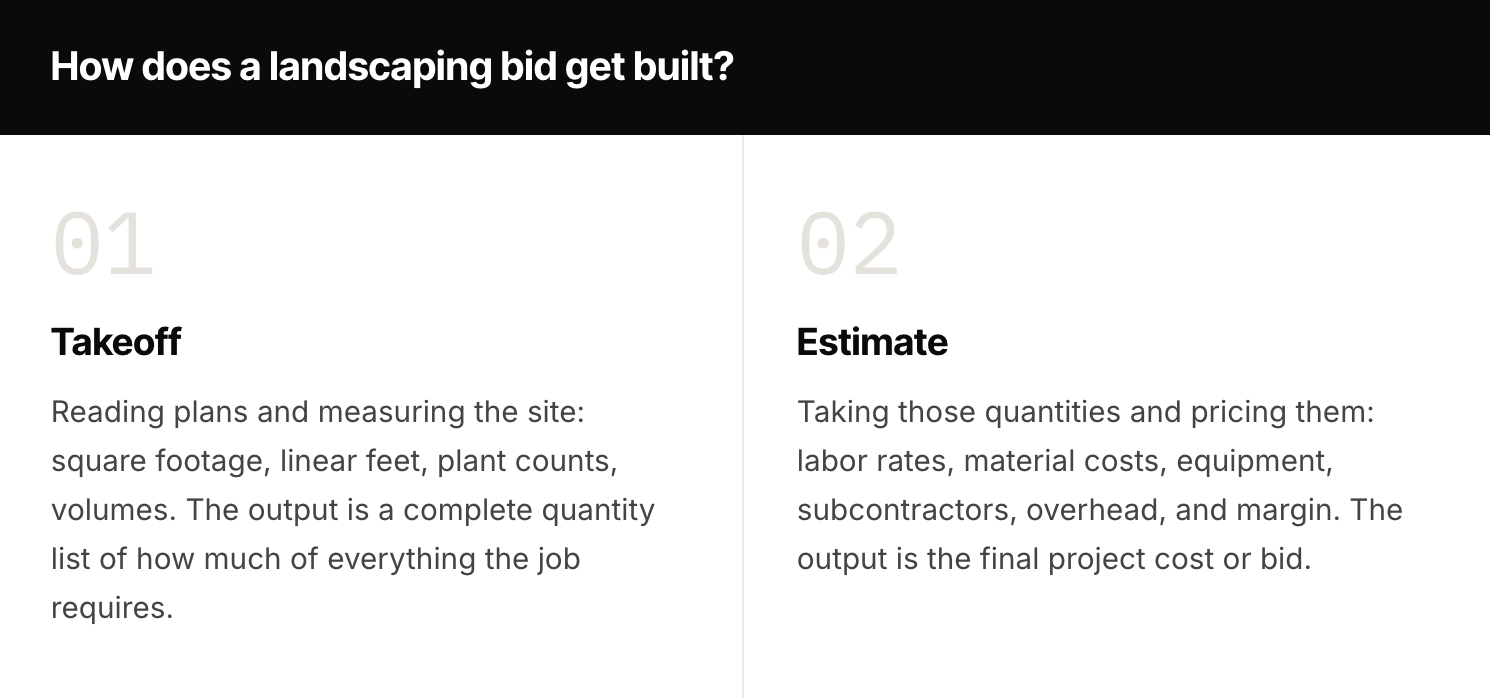 Estimates follow takeoffs, turning those quantities into project economics. Estimating teams combine takeoff output, with labor costs, material pricing, subcontractor costs, equipment costs, general overhead, and margin to produce the final bid. For these reasons, estimating should not be seen as “just paperwork.” It is the first operating model for the job.
Even small estimating mistakes cascade into larger downstream failures
Every major downstream decision depends on an estimate’s assumptions. Procurement depends on the materials and prices specified in the estimate. Labor planning depends on crew assumptions and labor rates. Scheduling relies on the expected duration of the job. The company’s margin depends on whether the estimate accurately captures the scope of the job.
A small mistake during estimating, therefore, can lead to larger downstream problems. An incorrect quantity, omitted material, underpriced labor quote or unrealistic scope does not remain only in the bid. Inaccurate assumptions can show up later as a procurement issue, schedule delay, cash-flow problem or even a hit to the company’s margins.
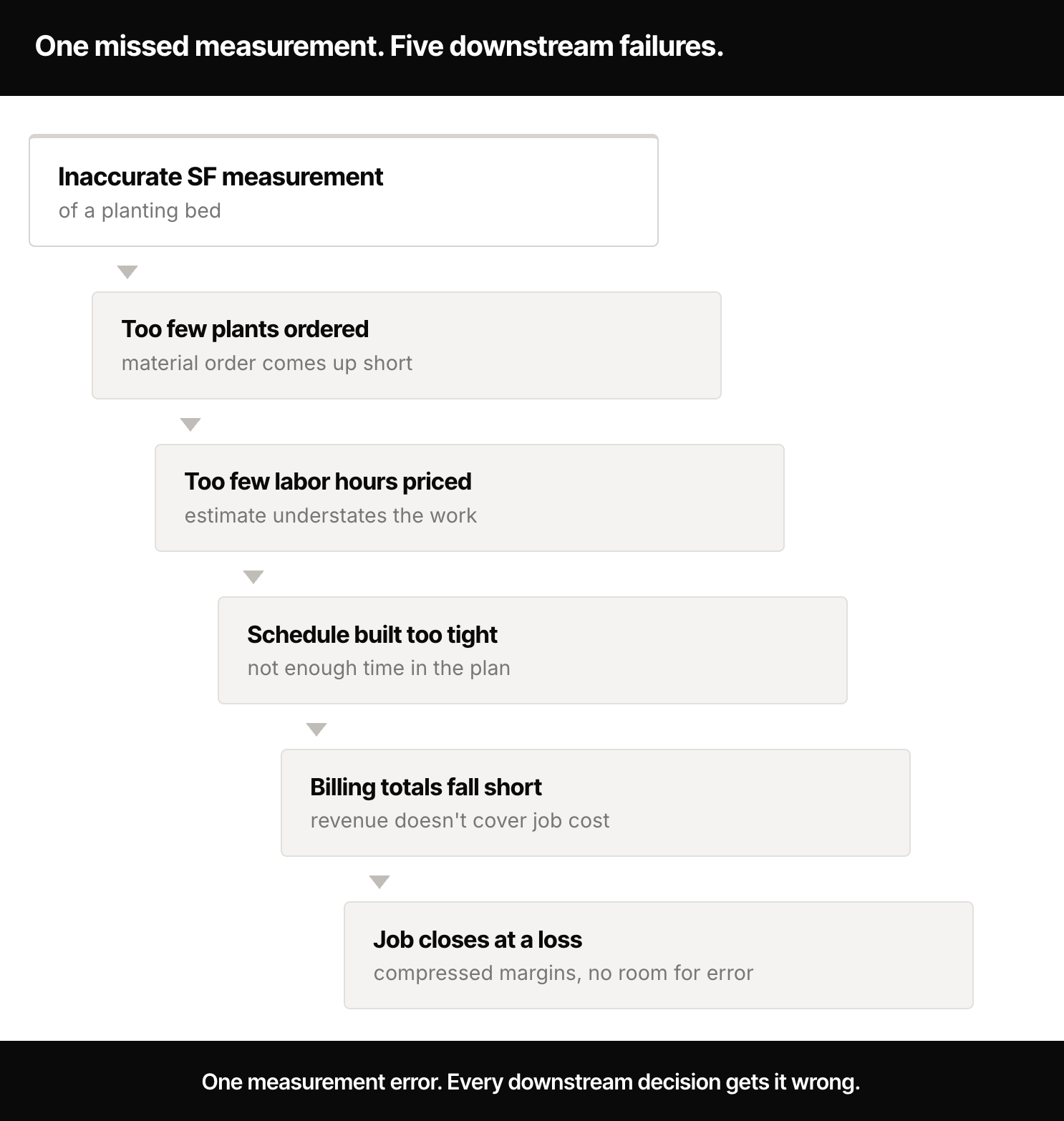
The estimating workflow should matter to investors precisely because it touches revenue quality, labor allocation, procurement, and project profitability. Companies that improve this workflow are introducing back-office efficiency and improving the quality of the entire operating plan.
Part 2: Workflows remains manual because they comprise the hardest-to-standardize knowledge
Estimating is the epicenter of the landscaping business, but its complex, analog processes can lead to incomplete or inaccurate efforts, keeping companies from profitability goals (4). It is one of the most important workflows in landscaping, but it has remained stubbornly manual because it encapsulates and concentrates so much of why investors view the industry as difficult to scale:
- No two projects are identical
- Site conditions vary
- Municipal requirements vary
- Inputs like labor availability, plant selections, materials prices, and client expectations change from job to job
The volatility of estimating inputs helps explain why so much judgement is required. Because the workflow relies so much on knowledge transfer, it is often difficult for companies to establish baselines (5). Experienced estimators are counting elements on a blueprint, yes; they are also interpreting plans and adjusting based on their experience. Their knowledge—how to deal with ambiguous scope, how to incorporate project risk, and other in-field constraints—is often not captured formally. Estimator knowledge instead exists in handwritten notes, annotations on PDFs, or email threads about site visits.
(4) FMI | Project Management Study | 2026
(5) CFMA | 3 Pitfalls in Project Accounting
Creating standardized guidelines for knowledge transfer is so challenging that nearly one-third of all construction projects move forward without an estimating baseline.With no baseline, companies cannot systematically compare actual outcomes to expected outcomes. They cannot make future estimates more efficient because every new project requires a new estimating workflow. Without these feedback loops, the estimating process remains an ad hoc knowledge transfer rather than structured operational guidelines that can easily scale for additional projects.
For outside observers, such as investors, the informal capture of domain knowledge is why estimating appears as administrative. The output is a bid proposal, and the underlying process seems haphazard and stuck in outdated technology. Landscaping companies may accept estimating as manual for the same reasons. It is simply easier to maintain judgement-based processes precisely because of how variable the task is.
The pitfalls of manual estimates are not limited to large firms, either. Twenty percent of small businesses cite project costing and estimating as their top operational challenge (6). To protect against the downstream effects of misestimates, landscaping companies pad margins, involve senior personnel, or accept that the workflow will remain a bottleneck. Yet estimating in its current form is not just an issue of underwhelming bottom lines. At its core, it represents a labor-leverage problem.
(6) Intuit | What is construction accounting? | November 2025
Part 1 of this series discussed the idea of maximizing labor leverage: performing tasks that are difficult to automate, require deep industry knowledge and/or experience and are directly tied to revenue generation. Landscapers that count symbols on blueprints by hand, draw their own lines and check- and re-check measurements spend entire workdays just preparing one bid. This is time that cannot otherwise be spent building client relationships or negotiating with suppliers.
This is the central issue of manual estimating. For operators, it represents a capacity constraint. But for investors, estimating workflows are untapped opportunities. Better systems could unlock operational leverage.
Part 3: Estimating is the operational layer that should attract capital and technological advancement
Estimating sits at the confluence of revenue generation, procurement, labor planning, scheduling, and financial forecasting. The process is also often a waiting game, wherein landscaping companies cannot complete estimates until they receive vendor quotes. Because of estimating’s location within the operational flywheel, and its inherent status as a bottleneck, even modest improvements in efficiency or accuracy can produce outsized returns.
Solving the estimating bottleneck may unlock broader productivity gains. Landscaping’s challenge mirrors that of the construction sector, where output per worker has stagnated despite technological advances. McKinsey projects that the construction sector, at its current productivity and demand trajectories, will see a $40 trillion output shortfall by 2040 (7). By McKinsey’s earlier estimates, closing the productivity gap would boost the sector’s value added by $1.6 trillion (8).
(7) McKinsey & Company | Delivering on construction productivity is no longer optional | August 2024
(8) McKinsey Global Institute | Reinventing construction through a productivity revolution | February 2017
Landscaping companies have begun to respond to this challenge. More are leaning on AI and other software tools to open operational bottlenecks. Mid-sized landscaping companies report saving around $100,000 annually with more efficient route optimization alone (9). Other businesses have targeted scheduling and weather adjustments. These workflows, while important, sit downstream of estimating. They improve outlooks but only after the company has scoped and priced the job.
This is why capital should target the estimating workflow. Standardized, scalable estimating would help landscaping companies produce bids faster. It would also help them structure the information that defines the job as well as the knowledge needed for nuanced adjustments. Because estimating happens at the outset of each project, modernizing its processes would, in effect, modernize the entire industry.
(9) AI Business OS | AI Adoption in Landscaping: Key Statistics and Trends for 2026 | May 2026
Industry tooling of the past was not transformative, but AI is changing what’s possible
And though some companies have implemented software, there is still room for improvement. The same McKinsey report that highlights a productivity shortfall notes that technologies deployed by the construction sector are “typically not yet deployed in a way that would fundamentally transform ways of working for the majority of workers.” That’s likely because many industry tools are old, difficult to use, require manual intervention to operate, and/or do not integrate well with other systems (10).
Indeed, one-third of construction companies say the technology they do have is a poor fit for their processes and procedures (11). Just thirty-eight percent of construction companies that use preconstruction software are happy with their current solutions. As a result, companies see low internal technology adoption rates or continue using tools that do not allow for maximum labor leverage.
(10) Andreessen Horowitz | Every Building You’ve Ever Been In Was Designed By Software Built in 1997 | March 2026
(11) PlanGrid & FMI | 2018 Industry Report Construction Disconnected | 2018
This tooling gap is a good fit for new solutions that make use of artificial intelligence and computer vision. Computer vision-enabled platforms are already deployed in the natural world. Currently, they are being used to understand how humans interact with the environment, forest management, and crop monitoring; but, they are not being used in all landscaping contexts (12, 13, 14).
(12) Prime Movers Lab | Computer Vision & The Environment | August 2023
(13) Scientific Reports | Mo Shanghao, Dai Zetian | Study on rural landscape design strategies integrating computer vision and deep learning: an analysis based on human perception and visual aesthetics | October 2025
(14) Voxel51 | Computer vision in agriculture: Impact in 2025 | September 2025
The industry needs tools that are a better fit for construction trades, offer more automation to eliminate manual intervention and complexity, and are easier to learn and adopt. While some takeoff and estimate software is beginning to incorporate AI features into their offering or making use of public GPT engines, few of them are true AI-native solutions with proprietary models trained on construction-specific data, blueprints, and workflows.
Fewer still are the companies developing the computer vision technology necessary to truly read and understand the lines, dots, and polygons that comprise a blueprint. Technology solutions that can truly digest blueprints and automate more of the takeoff and estimating process with these developments will help bridge the productivity gap by making each individual estimator more efficient so they can better focus their strategic time and energy instead of counting plants and measuring areas. They stand to not only be the best fit for construction companies, but also investors, because it’s in these developments that construction estimation processes can become more standardized and scalable, despite their complexity.
The firms that standardize and automate estimating may gain disproportionate advantages in labor leverage, scalability, and profitability. Some have even succeeded in doing so:

Improved estimating is the first step toward maximum leverage
The inability to realize full labor leverage, especially within estimating workflows, is existential. In the architecture, engineering and construction (AEC) fields, manual document review before estimates become bids takes weeks and costs between $50,000 and $100,000 per project, and one in four construction companies believes it is at risk of going out of business as a result of just two or three inaccurate estimates (15, 16).
(15) Andreessen Horowitz | Every Building You’ve Ever Been In Was Designed By Software Built in 1997 | March 2026
(16) Intuit | The importance of labor tracking and job costing in construction
For operators that have not affected change, modernized estimating is the first step toward building a more digital and data-driven organization. For investors, estimating is a frequent, high-stakes, and data-rich workflow that is tied directly to revenue. It decides whether or not a company will be profitable. Estimating is therefore the ideal target for parties wishing to solve landscaping’s productivity problem.
Part 3 of this series will show landscaping firms how they can adopt novel technologies for estimating as well as other workflows. It will help them on their way to becoming digital landscaping companies and reaping all the benefits that entails.
Blog hero image by Daniel McCullough on Unsplash